Variable
Category: Executor Tier: Basic
Purpose
Writes values into Local or Global variables, supports gameplay text-buffer flows with optional mask formatting, supports direct vector/array edits, and can sample native physics data directly into a variable without a GDScript bridge.
Visual Reference
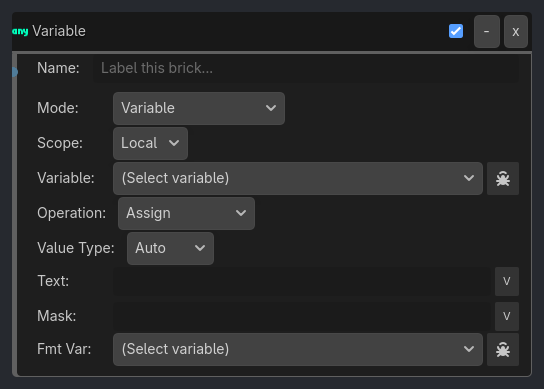
Properties
This brick does not expose a generated property table yet. See the source specification for implementation notes.
Notes
Empty
target_nodemeans “sample the owner node”1 Godot unit = 1 meter, so the stored magnitude is meters per secondThis executor stores the raw sampled number only; unit conversion and smoothing belong in
MathMask formatting is deterministic and separator-driven; it is intentionally not a general-purpose template language
Local and Global variable panels parse Array values with Godot Variant syntax first, preserving integer values instead of coercing all numbers to floats.